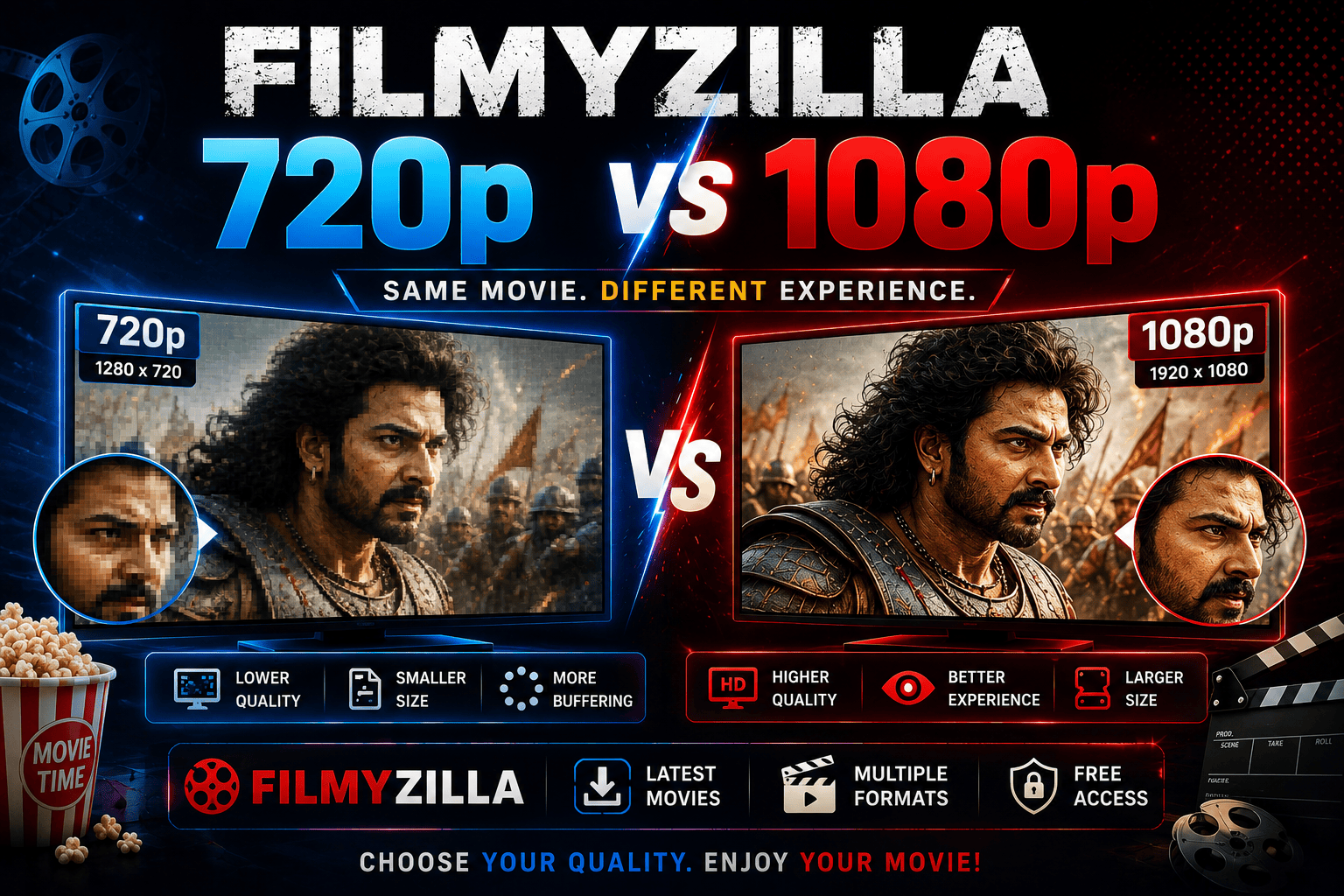
Filmyzilla 720p vs 1080p explained with clear quality differences, file size, streaming needs, and screen performance to help you choose the best option.
Not sure whether 720p or 1080p gives you a better movie experience? Filmyzilla 720p vs 1080p reveals the real difference in clarity and detail. See how screen size, file size, and streaming can affect your choice. Find out which quality delivers the sharper and more enjoyable viewing experience.
What Does 720p Mean?
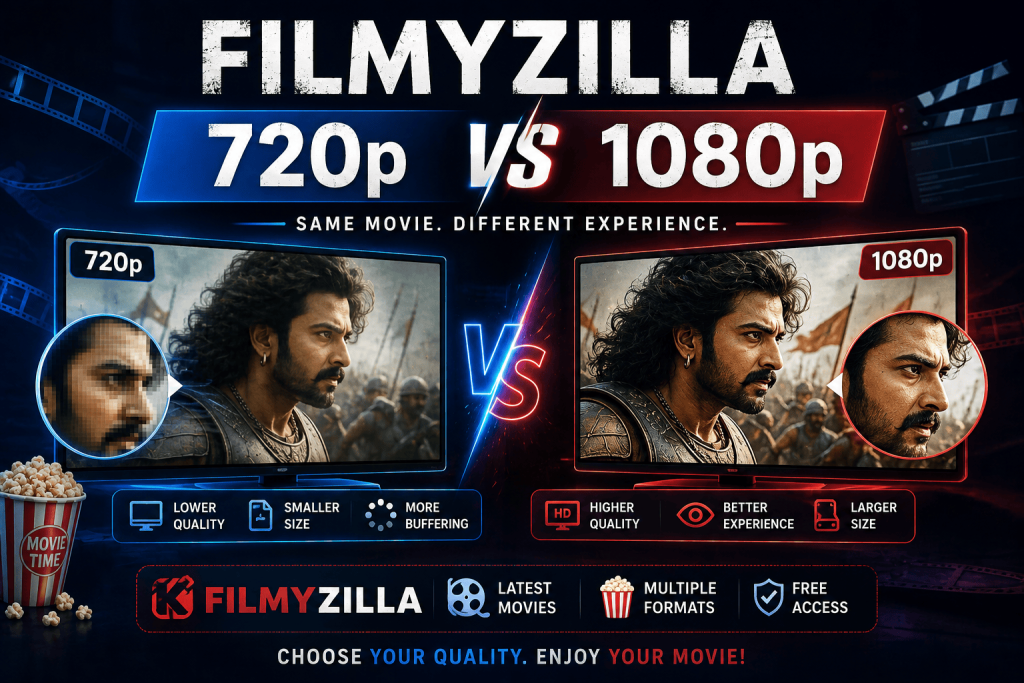
One video quality is 720p; 1280 by 720 pixels defines its description. The letter “p” stands for progressive scan, which helps the image to show progressively instead of in an interleaved version. Most people consider 720p to be high definition, sometimes referred to as HD. It appears pretty decent and provides a clear improvement over traditional definition film on mobile devices like phones, small screens, and tablets.
One big benefit of 720p is efficiency. A 720p video usually uses less bandwidth to transmit and has less pixels than 1080p, so its file size is less if all other encoding settings are maintained. This would help those with little storage or bandwidth. If the movie is shown on a smaller screen, a lower pixel count also means that some minute details might be missed.
What Does 1080p Mean?
Sometimes referred to as Full HD or FHD, 1080p has 1920 by 1080 pixels. 1080p has about 2.25 times as many pixels is 720p . This extra picture information allows appropriate displays to exhibit more texture, sharper edges, and more detail. For films, games, sports, and other sophisticated content, viewing on a larger screen helps one to see the differences.
More data and storage required for greater resolution video is the main compromise. Streaming it frequently can also call for a faster internet connection, particularly if the movie has a high bitrate.
Filmyzilla 720p and 1080p: Basic Differences
Observing their fundamental traits allows one to better understand the difference between Filmyzilla 720p and 1080p.
| Feature | 720p | 1080p |
| Resolution | 1280 × 720 | 1920 × 1080 |
| Quality Level | High Definition (HD) | Full HD (FHD) |
| Pixel Quantity | Around 921,600 pixels | Around 2,073,600 pixels |
| Image Detail | Good for smaller screens | Sharper and more detailed |
| Bandwidth Need | Generally lower | Generally higher |
| Large Displays | Less detailed | Excellent clarity |
| Small Displays | Usually sufficient | More detailed |
| Storage | Usually requires less space | Usually requires more space |
| Overall Quality | Good for casual viewing | Better for high-quality viewing |
The actual file size and streaming needs can vary because compression, bitrate, codec, frame rate, and audio settings also affect the amount of data a movie uses. Thus, resolution alone does not determine the overall quality of a movie.
Read more : Filmyzilla South Indian Movies
720p vs 1080p: Which Looks Better?
Only considering resolution, 1080p looks better since it utilises more pixels. Imagine viewing the same scene from a movie on a large television. The 720p version may blur little details like backdrop parts, facial features, textures, and typography. Keeping more clarity can help the 1080p version highlight the elements better.
Still, the difference in image quality isn’t always remarkable, particularly on smaller screens.
A little cell phone screen shows 720p rather sharply. Less screen might mean that 1080p’s more important material presented is not either highlighted by a regular viewing distance. Your viewing angle so affects your somewhat enhanced resolution.
Does Screen Size Matter?
Actually, really. The clear nature of the difference relies a great deal on screen size. A small phone or tablet with 720p could be quite enjoyable to look at. Because the pixels are compressed onto a rather tiny screen, the image could still seem fairly crisp.
1080p typically offers a major advantage on a big screen television, display, or projector. The picture shows more obvious flaws in lower-resolution material as it grows. Those watching on smaller devices thus usually find 1080p more beneficial than those on bigger ones.
720p vs 1080p for Streaming
One should also take into account these solutions yet another important factor is internet speed. A 1080p stream usually shows more visual information of the same length than a 720p stream does. Maintaining flawless playing might call for more bandwidth.
Ten eighty pixels offers a better view experience if your internet connection is quicker and more reliable. 720p could be a more sensible option if your connection is slow, inconsistent, or under a limited data cap. Reducing the quality of streaming could help to maybe lower the amount of data being sent, hence therefore maybe lessen buffering.
Still, resolution itself does not give buffering. Apart from Wi-Fi quality, video bitrate, network congestion, and server speed, the streaming provider also affects playback.
Filmyzilla 720p versus 1080p for movie watching
Your environment and device will significantly affect your choice between Filmyzilla 720p and 1080p, especially for film viewing.
Mostly better for a large TV, 1080p highlights several graphical elements that profited from more resolution. Closed captions, facial expressions, clothes, action sequences, and setting might all be improved. For recreational viewing at 720p, small phone screens might be adequate.
Another important consideration is that a better resolution does not always guarantee a source of higher quality. A poorly encoded 1080p video could look worse than a well encoded 720p one. This is because video quality is also influenced by other elements including bitrate, compression, source quality, frame rate, and encoding.
File Size: 1080p vs 720p
Storage is another field in which 720p could be superior. Normally, as 720p has less pixels, a video encoded at 720p will be smaller than a comparable 1080p edition. Smaller files are easier to move around and store. This is especially crucial if your device runs out of capacity.
Someone who is, say, keeping a lot of videos on a smartphone might want a lower-resolution version to help to free up space. On the other hand, someone with a lot of storage and a huge Full HD screen could want 1080p for the additional information it provides.
Always bear in mind that there is no universal file size variation. Two videos with the same quality could have very different sizes depending on their encoding choices.
Which Is Better for Gaming?
Most people that can run it for gaming would choose 1080p for their setup. The higher quality aids to improve game environments, characters, text, and interface features. Many contemporary games and programs are meant to run perfectly at Full HD and even higher resolutions.
Still, resolution is not the only important factor of gaming. A less powerful computer may have 720p frame rates more than those at 1080p. To prioritize performance, competitive players may sometimes compromise resolution or visual quality. The finest choice will depend on which visual detail or performance you most value.
Does 720p still meet requirements?
In fact 1080p is not useless simply because it reveals more detail; 720p is not useless.
Still a sensible choice for:
- Little screens on cell phones
- Old technology
- Internet access is not all that great.
- situations lowering data use
- Small-capacity devices
- unplanned video viewing
Though 1080p is thought of as Full HD, 720p is still an HD resolution. Many would find 720p to be entirely satisfactory for daily viewing, especially if they are watching on a smaller screen.
Should you choose 1080p?
Image quality should be given first attention, as most consumers with a compatible current display will find 1080p to be their best choice. More pixels mean crisper images. Big screens, movies, games, video editing, and moments when small features really matter all gain from it.
The negative is that material with better resolution might call for more storage, bandwidth, and processing capacity. If your device and internet connection can easily handle it, 1080p seems most sensible.
Fast advantages and drawbacks of 720p versus 1080p
Advantages of 720p
- Smaller files in several like encoders
- less bandwidth
- Perfect for small exhibits.
- On limited apparatus, it may be more successful.
- Good for mobile data savings
720p Disadvantages
- Image quality not particularly strong
- More muted presence on the prominent panels
- More obvious pixelation upon expansion
- Less fit when great clarity is required.
1080p’s benefits
- More complex pictures and better resolution
- More suitable for large displays
- Ideal for movies and gaming
- mostly supported by current technology
- Visual quality comes first; hence, a better alternative is sought.
1080p Disadvantages
- Typically requires more knowledge.
- One could wish for more storage.
- might call for more computing capability
- On really little devices, the change might not be evident.
Which one catches your attention?
Your personal setup will enable you to address the Filmyzilla 720p versus 1080p issue. Choose 720p if you wish to save storage, reduce data use, or view on a smaller screen where the change is less noticeable.
Choose 1080p if your screen is Full HD and you have enough bandwidth and storage capacity for superior-quality video.
Most modern movie watching would most likely profit from 1080p. 720p could still be somewhat passable for casual viewing on slow connections or small devices.
Final thought
Resolution, picture quality, screen size, and data consumption set 720p apart from 1080p. Though 1080p produces sharper, crisper photos, 720p helps to conserve storage and data. Demand for 1080p, improved movie quality, and large screens is often satisfied with a respectable watching experience by 720p even on sluggish internet connections or portable gadgets. Choose the feature that most closely fits your device and viewing needs.
FAQs
Is 1080p much better than 720p?
1080p provides substantially more pixels than 720p, so it can produce sharper and more detailed images, especially on larger screens.
Is 720p still considered HD?
Yes. 720p is classified as HD, while 1080p is commonly called Full HD.
Which is better for movies, 720p or 1080p?
1080p is generally better for movies when viewed on a larger compatible screen because it provides more detail and sharper visuals.
Does 1080p use more data than 720p?
Generally, yes, although actual data usage depends on bitrate, compression, codec, frame rate, and other encoding settings.
Can you notice 720p and 1080p on a phone?
You may notice a difference, but it is often less obvious on smaller screens than on large TVs or monitors.
Does 1080p mean better video quality every time?
No. Resolution is only one part of video quality. Source quality, bitrate, compression, encoding, frame rate, and audio can also affect the final result.