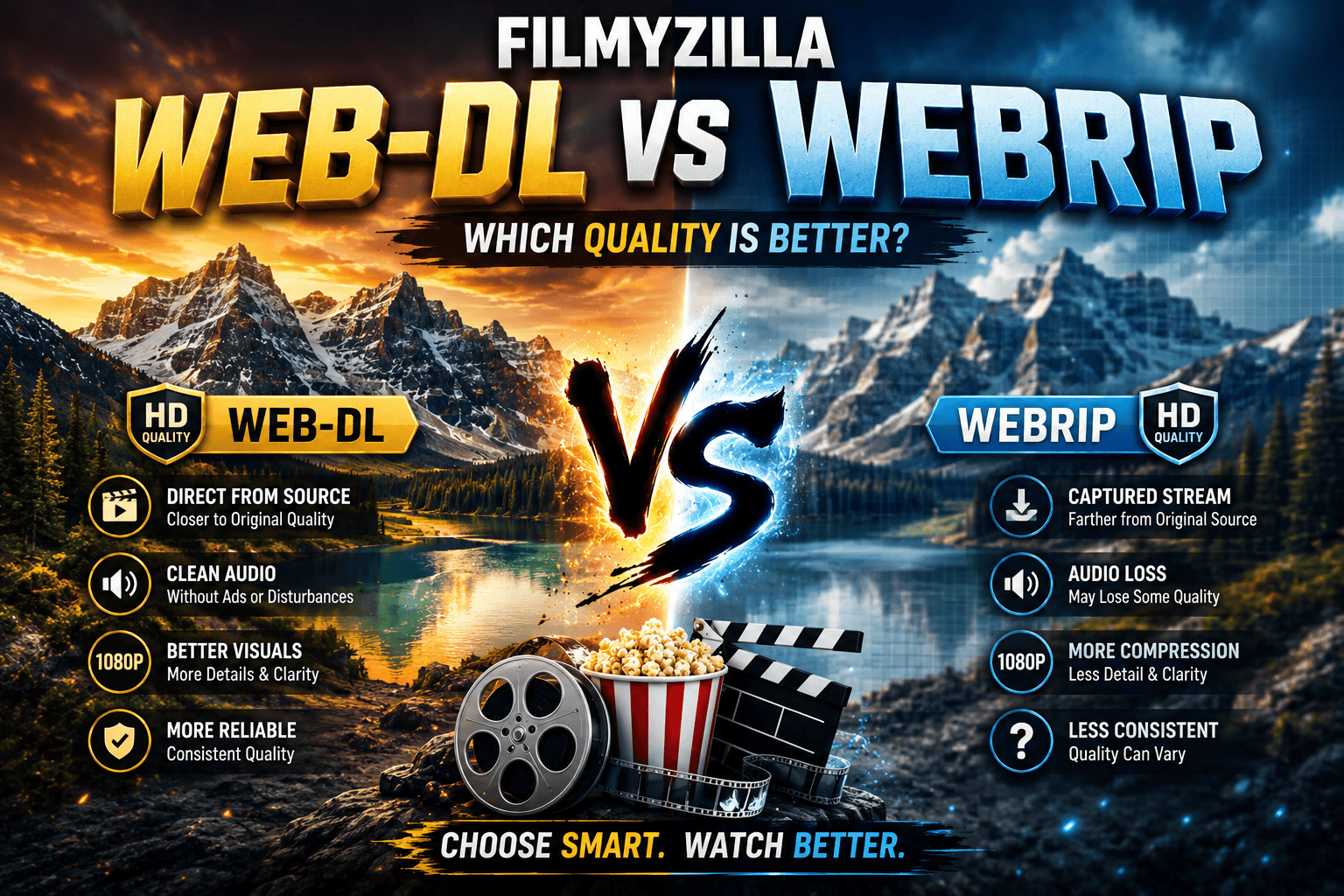
Learn the difference between Filmyzilla WEB-DL vs WEBRip, including quality, compression, audio, file size, and which format offers a better viewing experience.
Not all 1080p releases deliver the same viewing experience source quality matters. Filmyzilla WEB-DL vs WEBRip reveals the key differences hidden behind these labels. From sharper visuals to cleaner audio and smarter compression, every detail can matter. Discover which format stands out and why the right source can transform your viewing experience.
What exactly is WEB-DL?
WEB-DL is how Web Download goes. It often refers to a video file grabbed directly from an internet streaming service or a digital distributor.
A WEB-DL normally derives from the digital source itself instead of a screenshot most of the time. Usually less needless quality degradation follows from the reality that the original video stream need not be taken out of the display.
Usually, WEB-DL editions have clean audio and pictures free of the TV advertisements, logos, or other elements that could surface in broadcast captures. Whether the source is 5. Whether they could also aid in preserving their original audio and visual quality depends on the source.
The word WEB-DL however, does not inherently imply excellent quality. The actual outcome will depend on the initial streaming provider, bitrate, codec, resolution together with how the file was made.
What Does WEBRip Mean?
WEBRip is a video file produced from an online video stream using capturing or extraction techniques. Usually recorded then changed into another file is the streaming content. Re-encoding particularly at a lower bitrate can help to remove part of the content from the source video.
This is not suggesting that every WEBRip looks bad. Especially if the original stream is of high quality, a well-produced WEBRip can still have quite good audio and visual quality. Though WEBRip usually calls for more processing phase, WEB-DL usually originates from a direct digital source.
Filmyzilla WEBRip vs. WEB-DL: An Important Distinction
Understanding the differences between Filmyzilla WEB-DL and WEBRip is possible by means of their genesis and production methods.
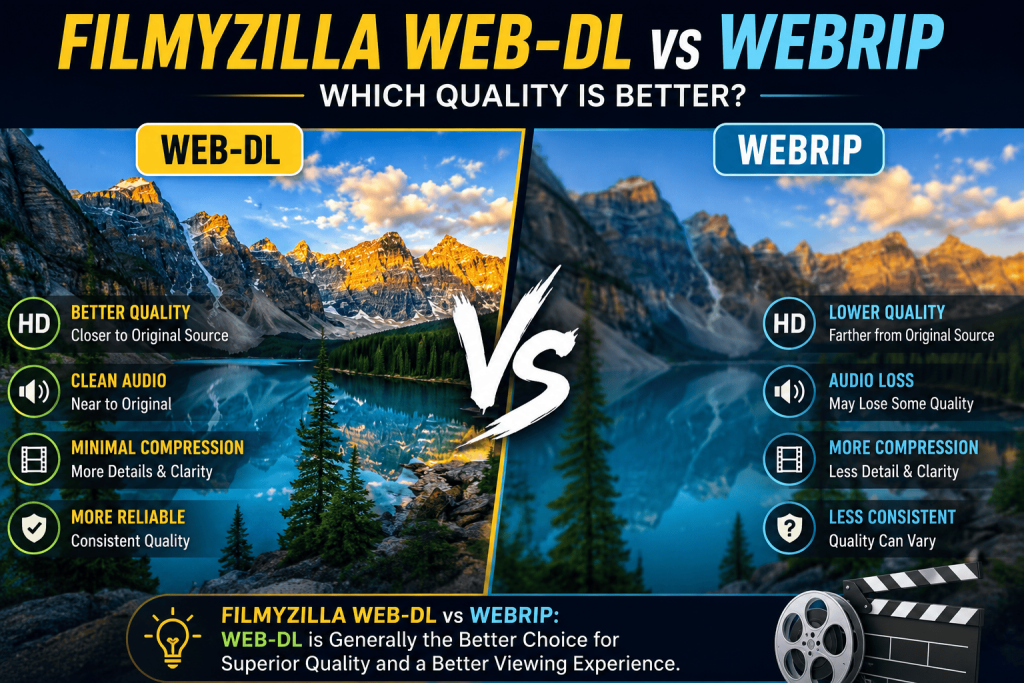
| Aspects | WEB-DL | WEBRip |
| Original Source | Direct website/digital medium | Web stream |
| Re-encoding | Usually none or not quite much | Often revised |
| Visual Quality | Most of the time superior | Could be slightly cut |
| Audio Quality | Usually near source | Could give up some points |
| File Size | Could be a little bit more | Could be smaller in scope |
| Consistency | Generally more trustworthy | Could differ significantly |
This study explains why two versions usually choose WEB-DL considering the same source conditions and resolution.
Read more : Filmyzilla 720p vs 1080p
WEB-DL vs WEBRip: Which Has Better Video Quality?
Usually, a WEB-DL has superior video quality than a comparable WEBRip. The main reason is more than the answer. A 1080p label only indicates how many pixels there are; it does not indicate how much compression was applied or how clean the original source was.
For instance, two files may look rather different even if they are both 1080p. While another can use more compression still keeping more detail, one could have more bitrate and show softer textures, blocking, or other compression errors.
Released from WEB-DL usually show more details when the underlying data is of remarkable quality and usually closer to the actual digital source.
Does WEBRip Always Have Poor Quality?
Absolutely not. This is a fairly important subject. WebRip is not always related to low quality. A decent WEBRip looks great on a TV, computer, or phone.
Elements of:
- Start starting streaming quality
- Video benchmarks
- One response
- Codec
- Variables for encoding
- audio bitrate
- Degree of compression
Occasionally a well encoded WEBRip will look virtually precisely like a WEB-DL. The so tag should be interpreted as an indication of how the file was produced instead of a very superior quality grade.
Resolution Is Not Everything
One of the most often made mistakes is thinking that two 1080p files have to have the same quality or that 1080p is always better than 720p.
The scene only has one feature: resolution. Among other essential factors are frame rate, audio encoding, bitrate, codec, compression, source quality,
A high-bitrate 1080p video can preserve significantly more detail than a heavily compressed 1080p file. A correctly encoded 720p file can also appear better than a poorly encoded 1080p release. This clarifies why just examining the data in a filename will give an incomplete picture.
Variations in Audio Quality
One should consider more than just video quality. Furthermore, the sound of Web-DL and WEBRip releases differ.
Direct digital sources help preserve the music’s flow depending on how the release was created. Strong compression can degrade the music’s quality by causing a WEBRip to need more processing.
Popular audio formats include AAC, AC-3, E-AC-3, and several other codecs. However, the presence of a specific codec does not always mean one file is superior. Also very important are the bitrate, channel setup, and source quality. Video and audio should be seen together for the best experience.
File size: WEB-DL vs WEBRip
Another obvious restriction is file size. Since they enable more data storage from the first digital source and a higher bitrate, WEB-DL files can be rather large. Re-coding or compression may help WEBrip files to be smaller.
An even bigger file does not always mean better quality. The codec and encoding choices determine storage effectiveness. Old or subpar encoding methods may need significantly more storage even if modern codecs offer fair visual quality at lesser file sizes. So, one should take file size together with bitrate and quality instead of the only determinant.
Show Two Designs at 720p and 1080p?
WEB-DL and WEBRip may have varied resolutions thanks to resolution, which shows the video’s size instead of how it was produced.
One may discover, among other things:
- WEB-DL in 720p
- WEB-DL 1080p resolution
- 720p WEBRip
- 1080p WEBRip
A 1080p WEBRip is more compressed, but its resolution is better than a 720p WEB-DL. This is one of the reasons for not viewing the words as exact synonyms of resolution labels.
Big Screens: WEB-DL vs WEBRip
A larger screen highlights the differences between the two shapes more. Small mobile screens could not adequately highlight little compression faults. However, softness, banding, blocking, and loss of little details may show up more clearly on a large TV or screen.
Either version would offer a respectable viewing experience if the source is of excellent quality and the encoding is quick. If there are comparable releases, still typically a superior digital source is selected.
Exactly what is 4K WEB-DL and 4K WEBRip?
Released in 4K also adheres to the same fundamental ideas. Though a 4K label doesn’t directly ensure amazing quality, it hints at a picture with great resolution. Source quality, HDR format, codec, bitrate, and compression are still quite important.
A high-end 4K digital source will still show amazing detail even if a standard compressed 4K file may not seem as amazing as hoped. Viewers should therefore check video files outside the 4K range.
Commonly Used WEB Release Phrasing You Might Run Across
The titles of movies and TV shows could have more words. Understanding them can help one to significantly streamline technical analysis.
Unbelievable Dynamic Range
With the help of the source and the display, High Dynamic Range (HDR) can give a broader range of color and brightness to create more subdued highlights and shadows.
One ought to either use HEVC or H.265
Designed to give fair visual quality while still allowing for quick compressing, HEVC (H.265) is a video codec. It could offer the same quality in a smaller file size as older codecs like H.264.
H.264
A frequently used technique of compressing movies, H.264 is mostly supported by high-definition video. Many device players and channels use it.
ACC
Often utilized audio codec, Advanced Audio Coding, or AAC, strikes a balance between acceptable file size and tolerable sound quality.
These words have many technical features and shouldn’t be confused with WEB-DL or WEBRip itself.
Which Format Should You Choose?
Usually the best choice for quality, a WEB-DL usually originates from the same sources and has the same resolution, therefore it is usually closer to the original digital source and so avoids the additional capture or re-encoding associated with several WEBRip files.
Still, the best choice is often guided by the content’s source, bitrate, codec, or encoding quality. For instance, a nicely compressed WEBRip could appear superior to a carelessly produced WEB-DL. Exactly for this reason, the collected file data all taken is absolutely vital.
Final thought
The Filmyzilla WEB-DL vs WEBRip comparison mainly depends on source and processing. WEB-DL is generally closer to the original digital source, while WEBRip may involve additional compression. When resolution and source quality are similar, WEB-DL is usually the better choice for a cleaner viewing experience. However, bitrate, codec, audio, and encoding settings can also affect overall quality.
FAQs
Is WEB-DL better than WEBRip?
Generally, yes. WEB-DL is usually closer to the original digital source, while WEBRip commonly involves additional capture or encoding. However, actual quality depends on the source and encoding settings.
Is WEBRip good quality?
Yes. A high-quality WEBRip can provide very good picture and audio quality. Its quality can vary depending on the original stream and compression used.
Is 1080p WEBRip better than 720p WEB-DL?
Not necessarily. 1080p provides higher resolution, but WEB-DL may have a cleaner source and better bitrate. Quality should be judged using more than resolution alone.
Why is WEB-DL sometimes larger than WEBRip?
WEB-DL may preserve a higher bitrate or more information from the original digital source, resulting in a larger file. WEBRip may use additional compression to reduce file size.
Does WEB-DL mean 1080p?
No. WEB-DL describes the source or release type, not the resolution. WEB-DL files can be available in different resolutions, including 720p, 1080p, and 4K.
Does WEBRip mean low quality?
No. WEBRip can still have excellent quality. The term mainly describes the way the web video was captured or processed, while the final quality depends on encoding and source conditions.