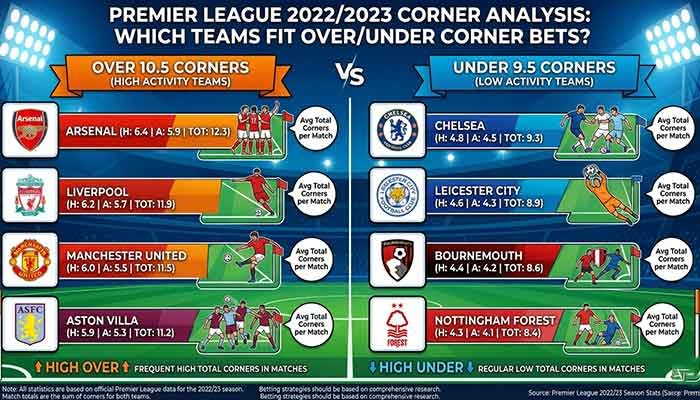
Corner markets in the 2022/2023 Premier League season rewarded bettors who focused less on goals and more on territory, crossing volume, and sustained pressure. When you understand which teams consistently generate or concede corners, the over/under corner lines become a question of tactical profiles rather than guesswork about random match swings.
Why corner-focused analysis is a logical betting angle
Corners are a by-product of repeated attacking actions, not isolated moments, so they tend to follow patterns tied to playing style and match state. Teams that bombard the box with crosses, maintain territorial dominance, and attack down the flanks naturally rack up more corner kicks, while compact, deep-block sides often concede them in clusters without necessarily conceding goals. That cause–effect chain makes corner totals a useful way to read how a match is likely to “look” physically and territorially, even when the final scoreline remains unpredictable.
How 2022/2023 trends framed corner expectations
Across a full Premier League season, the average match typically clusters around ten corners, with small variations driven by league-wide tactical trends and tempo. In 2022/2023, high-pressing, possession-heavy teams continued to generate sustained pressure and frequent box entries, which preserved that broadly high-corner environment and kept many games hovering near double digits. At the same time, the growing importance of set-piece coaching meant that corners were not just volume events but structured attacking platforms, encouraging certain clubs to chase them more intentionally as a source of goals.
Team profiles that push matches toward high corner totals
Some clubs effectively turn corners into a built-in feature of their game model. Sides that dominate the ball in the final third, fire a high number of crosses, and shoot often from inside crowded areas are more likely to force deflections and blocks over the byline, driving total corner counts upward. In 2022/2023, attack-minded teams with strong wing play and overlapping full-backs consistently fell into this category, frequently turning long spells of pressure into both shots and corner kicks rather than allowing moves to fizzle out.
These teams often played with inverted wide forwards and aggressive full-backs, encouraging repeated underlaps and overlaps that ended in blocked cut-backs. Their commitment to recycling attacks, rather than settling for one cross and retreating, created extended sequences where two or three corners could be won in quick succession. As a result, matches involving them tended to sit above the league’s average corner total, making the over line more attractive when they faced opponents willing to sit deep and absorb pressure.
Team profiles that drag corner counts downward
At the other end of the spectrum, some clubs naturally produce quieter corner landscapes. Low-tempo, possession-sharing sides that prefer to probe central areas rather than fire frequent crosses reduce the situations that lead to corners, especially if they rarely overload wide zones. Teams that defend in a lower block but funnel play away from the byline—forcing opponents into shots from distance or turnovers in midfield—also keep corner counts modest because they allow territory without allowing repeated box entries.
When two such teams met in 2022/2023, the result often looked like a compressed game with few deliveries from deep, limited bursts to the byline, and more attacks ending in blocked shots from central areas or turnovers rather than deflections for corners. Those matchups naturally leaned towards under-corner outcomes, particularly when neither side had a clear reason to chase the game early, since the tempo stayed controlled and the number of chaotic penalty-area scrambles remained low.
How match context shifts corner expectations
Even with a clear team profile, corner volume can swing with match state. A heavy favourite that falls behind early tends to increase tempo, commit more players forward, and cross more often, inflating corners as it leans on wide attacks to break a compact defence. Conversely, when a dominant team scores early and then controls the match without urgently chasing additional goals, it may circulate possession more conservatively, reducing the sheer number of box entries and, therefore, corner opportunities.
Weather and pitch conditions can also change the picture: slippery surfaces and swirling wind produce more defensive hesitations and emergency clearances, sometimes turning normally low-corner pairings into unusually busy set-piece contests. Recognising when external conditions or scoreboard pressure temporarily override the underlying team profiles helps prevent over-reliance on historical averages alone.
A basic table for categorising corner tendencies
Even without precise numerical tables for every club, you can still use a conceptual classification to guide over/under thinking. Consider three broad categories of 2022/2023 teams based on their tactical tendencies around corners:
| Category | Typical style traits | Likely corner impact |
| High-pressure, wide-oriented | Aggressive pressing, frequent crosses, high line | Pushes towards higher totals |
| Control-focused, central probing | Slower tempo, central combinations, fewer crosses | Keeps counts near or below avg |
| Deep-block, counterattacking | Defends deep, breaks quickly, limited sustained pressure | Creates asymmetrical corners (for vs against) |
This framework helps explain why some fixtures display consistently high corner counts, while others sit closer to the league average or below it. When both sides fit the first category, corner totals are likely to be inflated; when both fall into the second, under bets become more viable. Mixed matchups, where an aggressive favourite meets a deep-block counterattacking opponent, often create scenarios where the favourite’s corners climb while the underdog’s remain low, with the total determined by how long the defensive resistance holds.
Building a data-driven routine around corner numbers
Turning these observations into an edge requires a routine that structures how you use available statistics. A robust approach starts by tracking each team’s average corners for and against over a meaningful sample, split by home and away, and then comparing those figures with league averages to identify outliers. Adding information about how often specific clubs cross, how many shots they take, and where their attacks originate refines those averages into tactical fingerprints rather than just raw numbers.
Once those fingerprints are clear, you can evaluate each fixture by combining both teams’ tendencies, adjusting for expected match state based on relative strength and motivation. If two high-corner sides meet in a critical match where both need a win, the incentives and styles point toward an over scenario; conversely, two control-oriented sides playing a mid-table dead rubber may keep tempo low and corners suppressed. By making this evaluation systematic—rather than sporadic—you gradually separate signal from noise in corner markets.
Where UFABET can sit inside a structured corner strategy
For anyone who has already built pre-match rules around corner statistics, the question becomes how to integrate those rules with the tools they use to place bets. Suppose your process demands that a match meets specific criteria—such as both teams sitting above a certain average for total corners, a clear stylistic fit for wide attacking, and a likely game state where at least one side will chase the result—before you consider an over line. In that case, the next step is to match those conditions with available prices and stake sizing so that you only act when the odds offer a sensible risk–reward balance. Within that context, a bettor might choose to execute their corner-based ideas via 168 ยูฟ่าเบท, but the emphasis remains firmly on whether the bet passes the pre-defined filters and bankroll rules rather than on any particular feature of the service itself.
Using casino online environments when comparing corner markets
The growth of digital gambling ecosystems means corner markets are now widely accessible and easy to combine with other selections, which changes how some people manage their exposure. In practice, a bettor who already focuses on corners may use a casino online environment as one of several hubs where they check multiple sports sections, compare over/under corner lines across operators, and see how those lines react to late team news or tactical hints. The key analytical advantage is the ability to cross-reference your internal estimates—built from team profiles and averages—with the lines you are offered and then choose only those positions where a clear discrepancy exists.
At the same time, that convenience introduces a downside: rapid switching between sports bets and other gambling products can blur the mental boundary between structured, data-based decisions and impulsive, entertainment-driven wagers. To keep a corner-focused edge intact, it is crucial to maintain a separate mental or practical “accounting” for pre-planned, statistics-led positions and avoid letting attractive-looking combinations or bonuses nudge you away from your selection criteria.
Failure cases when relying on corner patterns
Even well-researched corner tendencies can fail when conditions change abruptly. Tactical shifts—such as a manager instructing full-backs to stay deeper or favouring short corners for control rather than direct crosses—can reduce corner volumes even for historically high-output teams. Injuries to key wide players or target forwards can lead to fewer aggressive deliveries, while a change in formation might move play away from the wings and into narrower central channels, altering the corner landscape overnight.
Match importance can also invert normal patterns: in high-stakes games, some sides reduce risk in possession, avoiding speculative crosses and favouring controlled recycling, which can cut down opportunities for corners compared with routine league fixtures. Weather can either spike corners, through more deflections and miscues, or suppress them if conditions make wide play impractical. Recognising these failure modes is essential because it reminds you that historical averages are a starting point, not a guarantee, and that each match still demands a fresh tactical and contextual reading.
Summary
Analysing Premier League 2022/2023 corner patterns is a reasonable way to approach over/under markets because corners arise from repeatable tactical and territorial behaviours rather than pure finishing luck. Teams that press high, attack wide, and sustain pressure tend to inflate corner counts, while control-oriented or deep-block sides often drag totals towards or below the league average. The most durable edge comes from combining team profiles, match context, and disciplined staking with careful use of digital betting environments, ensuring that each corner bet follows a clear, data-grounded cause–outcome–impact line instead of relying on intuition alone.